Showing posts with label God's Kingdom. Show all posts

Tuesday, January 19, 2016

The Marriage Feast

This sermon was preached to the people of 
Word of Hope Lutheran Church on Sunday, January 17, 2016.
The text for the morning was John 2:1-11.


Everybody loves a good wedding.  To be more specific, everyone loves a good wedding reception.  There’s dancing, there’s food, there’s family and friends, and a celebration of the love these two people have for each other.  And this morning in John, we even see that Jesus, his mother, and the disciples love a good wedding reception too.  And we also see that weddings where the Son of God are in attendance are not exempt from the cardinal rule of any social gathering - something will go wrong.
And in this instance, what went wrong was pretty terrible for a wedding in 1st century Israel.  They ran out of wine.  Now I was at some dear friends’ wedding a few years ago where they also ran out of wine.  Now it was no big deal, mostly because that particular group of friends are extremely goofy when we all get together.  We just had some soda and laughed and danced the night away.  This is not the case for 1st century Jewish weddings.  Wine was pretty much the only beverage you could serve and when the wine was out, the party was over.
And this isn’t a party that was only supposed to last for a few hours, this was a party that was supposed to last for at least a week.  Maybe more, depending on how wealthy the family was that got married.  Anything less would have been shameful and seen as a bad omen for the future of that marriage.  So, for the wine to run out on day 3?  Not a good sign at all.
And then after an interesting exchange with his mother, Jesus ultimately gives the family more wine, but he does it in one of those subtle, sneaky ways, that allows the family to keep their dignity and social standing.  You know, like Jesus does.  And then the author tells us that this was the first of Jesus’ signs that he performed in Galilee.
And then we’re left scratching our heads going, well sure, that’s impressive, but if it’s a sign what does it mean?  Does it mean that Jesus likes to party?  Does it mean that Jesus is a great social equalizer?  Does it mean Jesus sanctions weddings?  Does it mean that Jesus is a reluctant hero?  Does it mean there’s always going to be wine?  Is it a sign that this wedding is going to be great?  What does it mean, Jesus?  What does it mean?
So let’s look at the rest of the signs that Jesus does in John.  There’s a lot of healing, and feeding, and even some raising from the dead.  So what do they all point to?  I think these are signs that give us a glimpse at what life will look like in the kingdom of God.  There’s a lot of grace, there’s plenty of food, there’s no more illness, there’s no more pain, there’s no more grief, and there’s no more dying.  I think it’s safe to say these are all good things.
But really, let’s unpack why it might be important for this wonderful wine at a wedding to be considered a sign of God’s kingdom that is coming and breaking into the world.  Why a wedding and not, say one of the big religious festivals?  Why would Jesus want to use the occasion of a wedding to show what the kingdom of God will be like?
Well, one, because as I said before wedding receptions are kind łof awesome.  But also.  Throughout scripture, God’s relationship with the people of God has been likened to that of an old married couple.  God’s language of faithfulness is very similar to the language we use in our wedding vows now.  God’s promises are ones of fidelity and faithfulness through good and bad, God promises to care for God’s people, without hope or expectation of anything in return and God’s people make those promises in return - even though they don’t always know what those promises mean.  God even used the prophet Hosea’s marriage as very tangible metaphor for God’s relationship with God’s people.  
And it doesn’t stop there, there is still more scripture that refers to the kingdom of God as the marriage feast of the lamb.  And throughout the early Christian tradition there is reference to the church being the bride of Christ.  That we, the people of God are in this beautiful, holy, loving relationship with God that knows no end and that in the end of times, we’ll all be attending this magnificent wedding reception to celebrate that love that God has for us and we for God.
Which finally brings us back to Jesus, wine, and small town weddings in backwoods Israel.  For in this wedding of what was likely a poor couple, Jesus shows his disciples and us what the wedding feast at the end of time is going to look like.  Jesus turns around 180 gallons of water into wine.  Really good wine to boot.  Now 180 gallons is kind of hard to comprehend.  That’s enough wine for this party to keep going for at least a year.  And not just for those invited to the party, but for everyone in the village of Cana to join in the celebration for a year.  And in doing so, Jesus shows us a couple of things.
The first thing that Jesus shows us is that this a wedding feast that will not end.  There will be more than enough of the best of everything for all of us.  There will be plenty of wine for those who choose to drink, but there will also be plenty of food.  And because it’s heaven and I love food, I imagine it will be only the best food.  There will be burgers and hot wings, and fish and steak, and Indian buffets and Thai food, and Chinese take out food.  And you can eat as much of it as you want without getting fat!  Heaven.  
The second thing that Jesus teaches us is that the wedding feast is filled with grace upon grace.  That even when we think there’s enough, God will give us even more.  God will offer more than we think we deserve and more.  God’s love and faithfulness to us will just keep flowing and flowing, much like the wine did at this party.  And not only will that grace keep coming at us, each time we experience it, it will be better than the last.  God’s grace is without end.

And the third thing that Jesus’ sign at Cana teaches us is that all are welcome at the wedding feast.  There is more than enough for all to be able to partake.  There’s enough food and wine for everyone in the village to join in the Cana couple’s celebration and there’s enough food and drink for the whole world to join in God’s celebration.  All are welcome and all are invited to the table.  And the best part is, God promises that those three things won’t ever change - it’s all a part of that covenant God made with us.  Amen.  

Tuesday, May 20, 2014

Treasure in Clay Jars

This morning at the Festival of Homiletics, Dr. Walter Brueggemann preached a sermon about treasure and clay jars.  Specifically the ways in which we confuse our treasure with the clay jars that hold them.

For some reason this seems painfully obvious.

Is it painful because it's true?

Do we confuse our churches for the Gospel that is preached there?
Do we confuse the number of people in our pews for the size of the Body of Christ?

Or perhaps, the better question is why are we doing these things?

Why are these clay jars, fragile vessels that are meant to be broken and smashed to let the contents flow freely, so protected?

Why are we afraid to be broken in order for true healing to occur?

It's not because we're afraid of death, is it?

We proclaim loudly every Sunday that Christ has destroyed death, that there is no final separation between us and God, that even in the midst of tragedy there is still beauty and grace and love - because God is in those moments.

We profess it with the words of the Apostle's and Nicene Creeds. Christ died to destroy death.
We hear it all over the Epistles of Paul.
We sing it loudly, using some of my favorite Easter hymns (among others)

And yet, even in the light of Easter change is still painful and scary.

How do we embrace the fear of change and let it go?
How do we stare this fear and death in the face, and in spite of that still live as God invites us to live?

And that living invitation looks like:

Loving our neighbors as ourselves.
Feeding the hungry.
Caring for the sick.
Dining with outcasts.

We are invited to live in God's kingdom, where death has no power.

And that is the treasure.  Everything else is just a clay jar.

Tuesday, November 12, 2013

Blurred Lines

This sermon was delivered to the people of The Lutheran Church of the Nativity on Sunday, November 10, 2013.  The text that the sermon is based on is Amos 1:1-2; 5:14-15, 21-24.


What is justice?

Merriam-Webster defines justice as: the maintenance or administration of what is just especially by the impartial adjustment of conflicting claims or the assignment of merited rewards or punishments.

That seems a little lackluster for our text from Amos.  I mean, Amos’ words are full of what we might call “poetic justice.”  It’s language that is rich in imagery and meaning.  It’s full of passion and energy.  Merriam-Webster doesn’t seem to be doing the text much justice.

So then, where can we turn?  What about the justice that we see in movies and television shows?  Is justice something akin to what Robin Hood and Batman do?  Where people get their “just deserts” for lying, cheating, or stealing their way to wealth and prosperity.  Is God’s justice like that of a vigilante, who makes sure people get what’s coming to them, especially when the law fails?

A Batman-esque God seems to work.  Thinking of Batman Gotham City with it’s great disparity between the 1 percenters and the rest of the population is very similar to the Israel that Amos is speaking to in this mighty proclamation.  For both Batman and Amos, we see how the rich and wealthy are crying out because of the “filth and poverty” that surround them.  The wealthy in both cases seem to miss the fact that their misuse of power and money has caused the great disparity in both landscapes.  And both Batman and Amos work to bring about a justice that is comforting for those who have been oppressed, but is anything but comforting to those who have been oppressing the lower classes.

And this view of justice really speaks to us in our society today.  Remember the “Occupy Wall Street” and “I am the 99%” from a few years back?  We see in our very own country a wealth disparity that happens, typically at the expense of the middle and lower classes.  People in these lower classes that have been neglected by society turn to violence, drugs, and crime as a way of making ends meet because it looks like all other doors have been shut by them.  Voices cry out for justice all over the country - those who have money are discouraged by the violence and crimes of those who don’t have money.  And those who don’t have money cry out for a little more equality in the status quo.

This is exactly why heroes like Batman, Robin Hood, and others who “rob from the rich and give to the poor” are so popular.  We all want justice and we see it in Batman and Robin Hood.  

And yet, even this heroic view of justice seems to fall a little flat when we try to understand God’s justice.  God’s justice is filled with mercy and grace.  I’m not sure the last time I saw Batman be merciful to a bad guy.  

So, then what is God’s justice?

This “feels” like an important question.  We see the prophets in particular focus in on living justice.  Amos and Micah in particular focus on the fact that God doesn’t desire people to gather together and worship in a particular setting or by saying a few “right words.”  God doesn’t desire sacrifices.  God isn’t even looking for good singers or beautiful music.  God desires justice.

And if God desires justice, shouldn’t we know what that means?  Shouldn’t we have an idea what it is God is asking of us?  We don’t want to let God down?  

As I’ve been wrestling with this over the past week, trying to pin down an answer to what it means to live God’s justice I realize that it’s not as simple as coming up with a step-by-step guide to living a godly life.  I can’t live out a justice rooted in mercy and grace if I write it down into some sort of moral code or law, because as soon as I think I’ve got it phrased just right, I will immediately run in to some situation that breaks every idea of justice that I’ve just codified.

Try as I might, I will never be able to pin down exactly how to make justice roll down like waters.  I cannot describe how righteousness will flow like an ever-flowing stream.  I can only dream and imagine.

I can dream like Amos dreamed, of a day when the lines between the wealthy and the impoverished will be blurred.  Of a day when there will be no way to distinguish between those who had money and those who have never had money.  There will be no way to distinguish between the 1% and the 99%.  Amos dreamed of a day when no person would go without.  Of a day when God’s justice will come rushing down over the world, wiping away all of the walls that the wealthy have built to keep the poor out.

I can dream like Susan B. Anthony dreamed, of a day when the lines between male and female will be blurred.  Dreams of a day when we no longer look at a person’s gender to make decisions about their strengths and abilities.  Anthony dreamed of a day when no person would be turned away because of their gender.  Of a day when God’s justice will come rushing down over the world, wiping away the walls that men build to keep women out.

I can dream like Martin Luther King Jr. dreamed, of a day when the lines between black and white will be blurred.  Dreams of a day when there will be no way to distinguish between the two races.  Dreams of a day when there is no distinguishing where someone came from.  King dreamed of a day when no person would be excluded based on the color of their skin.  Of a day when God’s justice will come rushing down over the world, wiping away all of the walls that whites built to keep those who are of a different race out.

I dream the dream that women and men have been dreaming for thousands of years.  I dream of a day when we no longer say, “me vs. you” I dream of a day when we no longer exclude someone based on how much money they have, how they look, or who they love.  I dream of a day when no one is turned away because they are “different” or “weird.”  I dream of a day when God’s justice will come rushing down over the world, wiping away all of the walls that we build to keep the “others” out.

I dream the dream Jesus dreamed when he said, “Out of the believer’s heart shall flow rivers of living water.”  Or, to say it better.  “I dream of a day when those who carry my name do their part to tear down the walls that we have built around me and you, so that no matter who they are looking at, they see a brother or sister in the family of God. That those who truly worship me, come to the holy table, are swept up by the waters of justice, grace, and mercy, and flow into the world, creating new rivers and streams and waterfalls wherever they go, that all the world might experience the gift of new life found in the removal of these walls.”

Maybe we can define justice after all.  Maybe justice is being able to welcome our sisters and brothers in Christ all over the world back into the family.  Isn’t that what God wants?  God wants us to all be able to look at one another and no longer see rich or poor, male or female, white or black, straight or gay, Christian or Muslim, but rather to welcome the person we see standing there as a child of God.  To embrace their differences so that our differences might be embraced. To embrace their flaws so that our flaws might be embraced by them. To embrace and be embraced so that we might all find God’s healing and righteousness.

I love Amos’ dream, Susan B. Anthony’s dream, Martin Luther King Jr.’s dream, the dream of all of us who are dreaming God’s dream.  This dream of justice that overflows with compassion.  This dream that tears down walls in the name of God’s love for all people.  This dream of righteousness and relationships that allow all men and women, you and me, to become an “us” that lives in to the grace-filled life we experience in the Father, Son, and Holy Spirit.  Amen.

Thursday, November 7, 2013

Why? Why? Why?

Why is the sky blue?
Why is the grass green?
Why do we go to church?

Why?
Why?
Why?

Why is the most basic of human questions.  From an early age, we want to know why.  Why do things work the way that they work?  Why do we do the things we do?

And it's also one of the most frustrating questions that humans ask.  Too often when asked why, we respond with "Because I said so."  Or maybe if we're feeling frustrated we reply,  "Because."

So I repeat, why do we go to church?

Is it just "because?"

I hope not.

But, I feel, for many people in churches across the country and maybe even around the world, the answer really is, "because we've always done it."

We go because mom and dad took us.
We go because we want our kids to be raised in the church environment, even though it's not really important for us.
We go because it's what society expects of us.
We go because our friends are there.

We go just because.

Unfortunately our reasons for going to church don't cut it anymore.  People don't buy into this idea that church is something that we just do.

Our society is saying, "You keep giving us explanations that fall short.  We don't buy it anymore."

Church isn't something that mom and dad do with their children anymore.
Church isn't the only place for moral formation any more.
Church isn't expected of us from society.
Church isn't the only place we find friends and family.

Church isn't somewhere we go just because.

I'm not saying the church is dying.  That's not true.  We see it flourishing in many emerging communities.

I'm not saying anyone is "killing the church" by using outdated language and music - that's not true.  People will find meaningfulness in any language and music as long as they have a reason to search.

I am saying that we need to think about the reasons why we gather as the body of Christ.

Why do we gather on Sunday mornings?
Why do we want to talk to people about our faith?
Why do we help others?

Why?
Why?
Why?

Is it because we encounter God?
Is it because we want to surround ourselves with the faithful when we experience doubt?
Is it because we want to lose our sense of self in the mystery of God?
Is it because we desire true community that tears down walls between "you and me"?
Is it because we yearn to erase labels of race, gender, and sexuality?
Is it because we long to call ourselves Children of God?

I hope so.

Friday, September 20, 2013

Icons or Idols?

This is part three of my discussion on Peter Rollins How (Not) to Speak of God.  Click here for parts one and two.

A/theology, this tension between what we know about God and that we can't possibly know objectively anything about God, provides us some great opportunities as participants in the emerging conversation.  We must embrace this opportunity to recognize that our old models for evangelism are wrong and, perhaps more importantly, use this a/theology as a worship aid that creates space for God to work in our lives as the Holy Spirit wants, not as we want.

First, our old models for evangelism.  

As more and more people "freak out" by the lack of people in the pews, there is increasing talk of what it means to be a "missional" leader: to create spaces, worship services, etc. that invite the "no religious preferences" to come to our church or, perhaps more accurately, so that they offer their money to our projects.  And this tends towards a heaven/hell scare tactic, especially around more evangelical traditions or a "rational discourse" on God, especially with the more mainline Protestant traditions.  Rollins points out that these two options tend to "create thousands of converts with no heart." (38)  

Rather, we should be inviting people to encounter God in their own way. Like the smell of freshly baked chocolate chip cookies invite us to taste and see that they are delicious, so too should our methods of "evangelism" invite those to whom we are speaking to taste and see that The Lord is good.  

We are past an age where we can and should tell people what to believe anymore.  We have hundreds of thousands of people who claim to be Christian that don't really understand what that means outside of going to church on Sunday morning.  So why should they continue to go to church when they could be part of a club or team that is a more meaningful aspect their identity?  Christianity is, at its worst, a "feel good religion" that doesn't offer meaningfulness in our world.  The language we (as Christians) have been speaking is stale and archaic at times, and only by speaking the language of the culture can we truly show just how counter-cultural the Gospel really is.

The benefit of a/theology in the midst of this conversation is that we are reminded again and again that we do not need to keep speaking an archaic language to convey the good news of God's work in the world.  The parable of the dishonest steward doesn't mean anything for your congregation?  Translate it into the language that your people would understand.  Use a farmer or a CPA instead.  A/theology invites us to subjectively come to experience God in our lives, instead of just the lives of those who lived 50 years, 500 years, or 2000 years ago.  Again, subjectively here doesn't mean relativism, but intimacy.  God is a subject that we desire to experience again and again as we grow and learn, not an immutable object that becomes idolatrous.  

Second, a/theology creates worshipful space within ourselves.

When we recognize that God is not just who we say He (or She) is, but rather the great "I AM WHO I AM" itself a name that challenges our need to put labels on everything. We can stop demanding that God work in one particular way in one particular place.  God cannot be limited to working through the pulpit in a twenty minute didactic sermon.  God cannot be limited to Eucharist or Baptism (although as a good Lutheran, I fully expect God to show up there).  Instead we must open ourselves up to the "extraordinary means of grace."  

These are the means where the Reformers realized that God was at work, but not in the traditional ways we expect.  This is when God shows up because two or three are gathered, and the Spirit shows up to stir a love of God and neighbor in someone who was neither "religious nor spiritual."  This is when God reveals Godself in people like Mahatma Gandhi who, although not a Christian by any standard definition, embodied the radical nonviolence of Jesus in way not seen since. 

We can use a/theology as an icon, a worship aid, because God reveals God in the midst of a/theistic tension.  This only works if we recognize the difference between an icon and an idol.

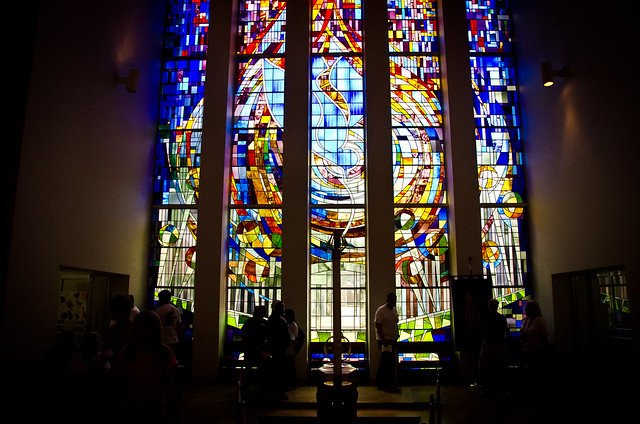
An icon is a prayerful tool that provides a glimpse of God and God's work.  It's an invitation to see how God's work may take different forms throughout the ages, but the work is still God's.  It's a stained glass window into the divine which allows us to see God's light, without going blind.  

Photo Credit: Tim Crummitt


An idol, is when this beautiful image that we use to help us glimpse God become as God in our minds.  It's almost too easy for this to happen to us.  C.S. Lewis talks about how a man looks at a particular corner every night as he prays and he eventually starts to see that corner as where God dwells instead of as a tool to help him focus his thoughts and feelings into prayer. (The Screwtape Letters)  We desire to make sense out of what confuses and astounds us.  We want objective and concrete facts especially when all there is to found is subjective knowledge.  We want answers even when the questions escape us.

A/theology, as icon, helps us steer clear from these idolatrous tendencies by reminding us to live in the tension and encounter God on God's terms, not our own.  We have to be careful with our a/theology so that we do not turn this a/theistic approach into an idol that replaces God instead of allowing us to encounter the living God. 

After spending two days at the North Carolina Synod's Fall Convocation, where the keynote presentations were on preaching, I really want to start thinking about how to incorporate this invitation to engage God on God's terms in my sermons.  How do I preach sermons that are iconic, not idolatrous?  How do I craft my words in such a way to remind people that they are staring at an impressionist painting, where they are encouraged to allow the painting to affect them?  How do I proclaim the good news as if I were baking cookies, inviting people to come closer and taste for themselves? 

The hard truth of the matter is, I'm not sure this is a question that I can objectively answer.  (There's that a/theology slipping in again...)  I think it's a skill that has to be developed contextually as each congregation needs different kinds of invitations.  Each member has their own experience and encounter with God that I am blessed to experience with them as we point out God's work in our lives to each other.  I cannot and should not see God for them, but I can model what it looks like to experience God in a variety of ways.  I can encourage them to look for where God is in their midst.  Shouldn't that be enough? Why not let the Holy Spirit do all the heavy lifting?