Showing posts with label A/Theology. Show all posts

Tuesday, October 22, 2013

How God Speaks through Us

This is my last engagement with Peter Rollins' How (Not) to Speak of God. 

 After many conversations about this a/theological approach to our faith, we cannot help but beg the question, "Which interpretation is the right one?"

After all, my dis/belief might be very different from your dis/belief.

Are they equally valid?

Am I right?

Are you?

How do we determine what is a helpful look at a/theology that allows God to speak to us where we are in our lives?

Peter Rollins posits that we look through all of these questions through a lens of love.  That is, is our interpretation of an experience/text done in such a way that love is the primary message being conveyed through our interpretation.

However, it is impossible for us to define how to interpret through a lens of self-giving and Christ-like love.  The Christ-like love we are to emulate in our interpretations is one that is charitable "above and beyond" what any instruction manual could ever say.  Trying to pin down precisely what is required - to turn the "above and beyond" into the norm - fails to recognize the radicalness of self-giving love.

This means, that we aren't able to concretely nail down one correct way to interpret scripture and ethics.  Instead, it's something that we must be able to feel through and work out on a case by case basis.

Our interpretation in love in one situation isn't always going to be our interpretation in love in another situation.

This brings us to the importance of the community's role in faith.  We must continue to talk through our struggles with one another - to continually be re-interpreting our faith through the lens of love.  And we must continue to hold up all of these interpretations together in a dis/unity that allows us to embrace the mystery that God presents to us through scripture, tradition, and experience.

As one thinking about how to accompany people as we all continue to walk on our faith journey, this presents a tremendous challenge but also a wonderful opportunity.

The challenge is that simply talking about people about God is not the solution.  It never was, isn't now, and won't be in the future.  Instead we must listen to where people are; we must listen to where God is working in the lives of those around us.  We start our conversations about God where the other person is - and not from the belief that they should be where we are now, but rather that we can find a new direction together.

Finding that new direction together is the wonderful opportunity that we have been given.  We are on the frontier of a new conversation about God and it's one that will allow us freedom to play and explore God's mystery and hypernymity together.

We need not speak of God, but rather allow God to speak through us - our thoughts, words, and deeds.


Wednesday, October 2, 2013

Seeking Because We Are Found

This is stage four of my engagement wtih Peter Rollins' How (Not) to Speak of God.  For parts one, two, and three click here, here, and here.  

"So I say to you, Ask and it will be given you; search, and you will find; knock, and the door will be opened for you.  For everyone who asks receives, and everyone who searches finds, and for everyone who knocks, the door will be opened." Luke 11:9-10
I think this is our culture's favorite passages.  We love the idea that we can ask for anything and it will be given to us.  We want to find when we seek.  We want the door to be opened when we knock.  More importantly, we want it now.  We want to get the things we ask for immediately.  Sometimes, we want to have what we're asking for before we even ask it.

This is espeically true of our relationship to God, I think.  We want God to know what we want and we want God to give it to us right now.  We, at some level, really believe that only good things should come to us because we are Christians.  

We hear this message time and time again.  "Turn over your life to Jesus and then everything will be ok."  

So people "convert" in an attempt to make their life perfect.  They want to avoid pain and suffering.  They want to make sure they have enough money to get through to the end of the month - or they want to write a check that absolves them of all obligation to actually get to know and care for their neighbor.  

They go to church and expect everything to be wonderful forever.

And then bad things happen.

This is something we've all experienced.  People we care about die.  We get sick.  Sometimes there's not enough money at the end of the month.  Our lives are not as wonderful as we think they should be, especially because we've become "Christian."

So then we stop going to church.  We stop putting money in the offering plate.  We stop identifying ourselves as Christian.

We miss the point.

We don't go to church because the pastor has all the answers.  We go to church precisely because the pastor doesn't have the answers.

Let me explain this.

We've talked about how our worshipful attempts to understand God's identity and action in the world are, at their heart, a/theological.  They both affirm and question our traditional understandings of God and stir up in us a desire to listen and learn from other understandings of God - while continually affirming and questioning the differing perspectives we hear.

Rollins points out that this ongoing quest for God and trying to put God in to words becomes spiritually transformative.  In desiring change we become changed - we embody the change that we want to see within ourselves.

For example, people who want to become healthier.  

They must start to make conscious decisions that will help them as they strive for their goal.  They need to begin making healthier food choices, stop eating out, start excercising - learn self-restraint.  In doing so, when successful, the change happens because their mindset has changed.  They begin to live healthier because of their desire to be healthy. When it is said and done, they no longer have to make conscious healthy choices, because they have transformed their mindset from unhealthy to healthy.

Likewise our search for God is transformative.  Our desire to know God stirs up in us changes within our heart that make it possible to see the aftermath of God's work in the world.  That's one of the primary jobs of pastors - to search with those who seek God and help identify God's work in their lives.

We cannot and should not create a "one size fits all" model for how God works in the world.  How God has worked in one person's life is not how God will work in another's.  

And that's beautiful.  

This is good news because God knows so much about us and our lives that God is going to give each of us individualized care and attention.  

However, this means that the pastor (spritiual leader/friend/whomever who want to talk to about God) is not going to have answers immediately for you.  Sure she (or he) will be able to give you some traditional answers - for example what's in the Lutheran Confessions, but that's not necessarily helpful for identifying where God is in your life at this moment. 

So we go to church.  

We live in community.  

We talk to one another.  

We listen.  

We learn and we help point to God's work in our lives based on scripture, tradition, but we also cannot discount personal experience and intuition.  We must work to be pastors to one another by walking with each other as we all seek God.

And we seek God precisely because God has reached into our lives and given us an experience of God.  For many of us, that happened in baptism.  God acted in our lives and we spend the rest of our time together trying to stumble around and seek the One who has found us.  

Friday, September 20, 2013

Icons or Idols?

This is part three of my discussion on Peter Rollins How (Not) to Speak of God.  Click here for parts one and two.

A/theology, this tension between what we know about God and that we can't possibly know objectively anything about God, provides us some great opportunities as participants in the emerging conversation.  We must embrace this opportunity to recognize that our old models for evangelism are wrong and, perhaps more importantly, use this a/theology as a worship aid that creates space for God to work in our lives as the Holy Spirit wants, not as we want.

First, our old models for evangelism.  

As more and more people "freak out" by the lack of people in the pews, there is increasing talk of what it means to be a "missional" leader: to create spaces, worship services, etc. that invite the "no religious preferences" to come to our church or, perhaps more accurately, so that they offer their money to our projects.  And this tends towards a heaven/hell scare tactic, especially around more evangelical traditions or a "rational discourse" on God, especially with the more mainline Protestant traditions.  Rollins points out that these two options tend to "create thousands of converts with no heart." (38)  

Rather, we should be inviting people to encounter God in their own way. Like the smell of freshly baked chocolate chip cookies invite us to taste and see that they are delicious, so too should our methods of "evangelism" invite those to whom we are speaking to taste and see that The Lord is good.  

We are past an age where we can and should tell people what to believe anymore.  We have hundreds of thousands of people who claim to be Christian that don't really understand what that means outside of going to church on Sunday morning.  So why should they continue to go to church when they could be part of a club or team that is a more meaningful aspect their identity?  Christianity is, at its worst, a "feel good religion" that doesn't offer meaningfulness in our world.  The language we (as Christians) have been speaking is stale and archaic at times, and only by speaking the language of the culture can we truly show just how counter-cultural the Gospel really is.

The benefit of a/theology in the midst of this conversation is that we are reminded again and again that we do not need to keep speaking an archaic language to convey the good news of God's work in the world.  The parable of the dishonest steward doesn't mean anything for your congregation?  Translate it into the language that your people would understand.  Use a farmer or a CPA instead.  A/theology invites us to subjectively come to experience God in our lives, instead of just the lives of those who lived 50 years, 500 years, or 2000 years ago.  Again, subjectively here doesn't mean relativism, but intimacy.  God is a subject that we desire to experience again and again as we grow and learn, not an immutable object that becomes idolatrous.  

Second, a/theology creates worshipful space within ourselves.

When we recognize that God is not just who we say He (or She) is, but rather the great "I AM WHO I AM" itself a name that challenges our need to put labels on everything. We can stop demanding that God work in one particular way in one particular place.  God cannot be limited to working through the pulpit in a twenty minute didactic sermon.  God cannot be limited to Eucharist or Baptism (although as a good Lutheran, I fully expect God to show up there).  Instead we must open ourselves up to the "extraordinary means of grace."  

These are the means where the Reformers realized that God was at work, but not in the traditional ways we expect.  This is when God shows up because two or three are gathered, and the Spirit shows up to stir a love of God and neighbor in someone who was neither "religious nor spiritual."  This is when God reveals Godself in people like Mahatma Gandhi who, although not a Christian by any standard definition, embodied the radical nonviolence of Jesus in way not seen since. 

We can use a/theology as an icon, a worship aid, because God reveals God in the midst of a/theistic tension.  This only works if we recognize the difference between an icon and an idol.

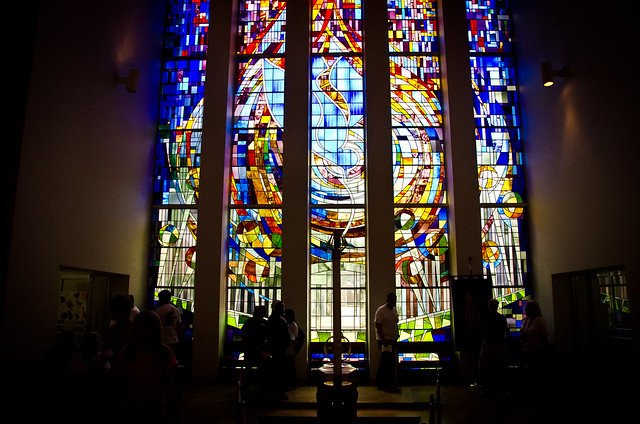
An icon is a prayerful tool that provides a glimpse of God and God's work.  It's an invitation to see how God's work may take different forms throughout the ages, but the work is still God's.  It's a stained glass window into the divine which allows us to see God's light, without going blind.  

Photo Credit: Tim Crummitt


An idol, is when this beautiful image that we use to help us glimpse God become as God in our minds.  It's almost too easy for this to happen to us.  C.S. Lewis talks about how a man looks at a particular corner every night as he prays and he eventually starts to see that corner as where God dwells instead of as a tool to help him focus his thoughts and feelings into prayer. (The Screwtape Letters)  We desire to make sense out of what confuses and astounds us.  We want objective and concrete facts especially when all there is to found is subjective knowledge.  We want answers even when the questions escape us.

A/theology, as icon, helps us steer clear from these idolatrous tendencies by reminding us to live in the tension and encounter God on God's terms, not our own.  We have to be careful with our a/theology so that we do not turn this a/theistic approach into an idol that replaces God instead of allowing us to encounter the living God. 

After spending two days at the North Carolina Synod's Fall Convocation, where the keynote presentations were on preaching, I really want to start thinking about how to incorporate this invitation to engage God on God's terms in my sermons.  How do I preach sermons that are iconic, not idolatrous?  How do I craft my words in such a way to remind people that they are staring at an impressionist painting, where they are encouraged to allow the painting to affect them?  How do I proclaim the good news as if I were baking cookies, inviting people to come closer and taste for themselves? 

The hard truth of the matter is, I'm not sure this is a question that I can objectively answer.  (There's that a/theology slipping in again...)  I think it's a skill that has to be developed contextually as each congregation needs different kinds of invitations.  Each member has their own experience and encounter with God that I am blessed to experience with them as we point out God's work in our lives to each other.  I cannot and should not see God for them, but I can model what it looks like to experience God in a variety of ways.  I can encourage them to look for where God is in their midst.  Shouldn't that be enough? Why not let the Holy Spirit do all the heavy lifting? 

Saturday, September 14, 2013

God is (W)Here?

All men naturally desire knowledge; but what good is knowledge without the fear of God? Surely a humble peasent who fears God is better than a proud philosopher who, neglecting his own soul, occupies himself in studying the course of the stars. - Thomas á Kempis

This passage is from one of the morning prayer offices found in The Little Book of Hours.  It came up (thank you Spirit) as I was pondering what to write about the next chapter in Peter Rollins' How (Not) to Speak of God. For part one on this book click here.  

Rollins second chapter addresses a postmodern approach to thinking about theology and what theology can tell us about God.  

*Spoiler Alert* it's not much. *End Spoiler Alert*

The problem with our understanding of God, who God is, and what God is up to in our lives stems from a previous post on if we can objectively know anything about the world.  Again, click here if you missed it.  This is where Thomas à Kempis comes in above.  He so kindly reminds us that we can try and know things, but if we don't have a fear (perhaps reverance is a better word) towards God all our knowledge will come to naught.  

Rollins reminds us (me in particular) that we can search and should search for God, but if we don't hold our beliefs in some kind of a/theistic suspension we can get ourselves in trouble with the idolatry of ideology.

Let me take a second to explain what I mean when I say "a/theistic suspension."  By this, I'm not advocating that we all take up the belief that God doesn't exist.  Rather, that seems more in line with an "anti-theism" which Rollins describes in this chapter.  Instead, I think that we should be more willing to re-examine our belief system that we hold about God, and disbelieve the particulars within that system - our atonement theories, for example.  The main point is that when we continually re-examine and deconstruct our theology, we are able to keep looking at what is helpful for coming to an understanding of God and then let go of what might be harmful for looking about God.

This is something that is evidenced throughout the scriptures - Old and New Testaments.   God as depicted in the Old Testament seems completely different from God as depicted in the New.  Many Old Testament depictions of God can be seen as vindictive or in need of sacrifice, while the New Testament God depicts a God that is of peace and love.  While simplistic, this contrast points out how as each author of each text comes to encounter God (from exodus, to exile, to the return, to the person of Jesus) they record one more glimpse of the character of God.  Their writings witness to the continual questioning done by the Hebrew people and then the early Christian church as they took what they knew about God and compared/contrasted it with their new experience of God - an a/theistic suspension of sorts.

So, keeping this a/theistic suspension in mind, our knowledge of God was never intended to be an objective fact, but rather a subjective and intimate knowledge that is evidenced by our relationships with close friends and family.  In fact, the very thought that our primary knowledge of God is subjective and intimate (subjective here not being relative, but rather a way of saying that we see God as something beyond height, weight, gender, etc.) is a gift for our minds could not handle an objective knowledge of God.  

This is what I hope Thomas á Kempis meant when he describes the "fear of God."  This intimate and subjective knowledge that is an expression of love for and from the almight Creator of the Universe.  A fear that comes out of respect for power and majesty, that also creates the space for a communal relationship with the Trinity.  

So then, what of (our attempts at) theology?  Have the past 2000+ years of Judeo-Christian theology been for naught?

I think it is safe to answer this question with a resounding "No!"

Our denominational theology and traditions are done as prayerful responses to God.  From the apostolic fathers to the mystics, to the medieval scholars to the reformers, and through our own experiences today, we all have some experience of God that we try to understand.  Theology then, becomes a way of processing through that experience of God and filtering it through the lenses of what we know and don't know.

I personally find this to be extremely liberating and freeing in one sense.  It means that I do not have to tie myself down to ideas and thoughts about God that aren't helpful or useful anymore.

Penal substitution is one such idea, that from which I feel freed.  This idea was incredibly popular for much of the Middle Ages as a way of understanding Jesus' death and resurrection on the cross.  To be fair, when Anselm was describing the penal satisfaction model for atonement, it was helpful  The Medieval scholars would have understood his writing through the lenses of the feudal system that permeated the context of Western Europe at the time.  However, this particular aspect of theology doesn't quite lend itself to the currently Western thought of individual justice and individual action.  Therefore, we have tried to make sense of the medieval atonement theory in our modern context instead of working through Jesus' incarnation, life, death, and resurrection for ourselves based on the accounts that we have in scripture (which are in and of themselves theological interpretations on the person of Jesus Christ, based on the culture that springs up after the fall of Jerusalem in 70 CE)

At this point, a lot of people give up because this is hard work.  It's near impossible to come up with an objective explanation of how God works in the person of Jesus Christ, when we aren't looking at a candid photograph of Jesus, but rather an impressionist painting done based on oral traditions of who Jesus was.  Which is kind of the point, I think.  It's not about having an objective grip on God the Father, Son, or Holy Spirit.  It's about coming to an intimate understanding of how God grasps us and holds us in faith, so that we might be joined to the Kingdom of God, now and not yet.

All of this is an awful lot of groundwork to get to what I found to be one of the most exciting ideas presented in this chapter - the hypernymity of God.

Hypernymity is the opposite of anonymity.  Instead of having little to no information about God - which might be seen to be the base assumption based on what I've written above, we have far too much information about God.  We are trying to process hundreds of thousands of experiences of God - big, little, and everything in between.  There is so much information about God, that each and every person who encounters God might walk away from their encounter thinking they've experienced an entirely different God from their neighbor (which brings us back to the comfort of a/theology in that we are always re-evaluating our own experiences of God in light of the community's experiences of God).  At times we are frustrated because we feel we haven't gotten to know anything about God, at all.

However, this is not the case.  Instead of thinking that we have not learned anything of God, we must learn to live within the tension created by multiple experiences of God.

The idea of hypernymity is witnessed to in some of the "conflict" in the differences within scripture between the immanence and transcendence of God. The idea of hypernymity is such that God is so immanent, so intimately involved with every single created thing, that God is transcendent that we can no longer process God's presence and so God has become immanent.  God's very existence permeates everything and God is so fully revealed that our human brains are incapable of processing just how present God is and how open God is.  We revert to our sensory experiences even though our very souls cry out to be united with the God that is right there, so in front of us, that we cannot see it.

Jay Gamelin at Pilgrim Lutheran Church preached about something similar at his Easter sunrise service in 2013.  The illustration he used that I find helpful when thinking about this type of idea was that of Mount McKinley as seen from Anchorage Alaska.  When you are on the ground in Anchorage, you are able to see Mt. McKinley However, it permeates the landscape so much that it is almost hard to see the shape of the mountain because it takes up all of our vision.

Now imagine standing on the ground looking up at this.

So too, is our experience of God.  God is so present that we are unable to put clear definitions around who God is and how God is working in our world.  The best we can do is make out fuzzy areas where we are able to identify God's work in some way, shape, or form whether it is as Creator, Redeemer, or Spirit.  But we also recognize that those identifications of God are, at best, like impressionist paintings.  They capture one person's experience without putting clear boundaries on what that experience is.

I find this idea that God is so present in the world, that my fallen nature has to filter through God's activity in the world just in order to survive to be comforting.  For me, this is a way of dealing with doubts, questions, and concerns about how God is acting in the world and that God is, in fact, present in all of my struggles.

God is there in all things.  God is in the grief of the mother who has lost a child, because God has also lost a child and understands the grief that is present.  God is in the anger, the sadness, the loneliness - in all of this, God is present.

God is so present, in fact, our own emotions are intensified because God participates in them with us.  Yet, because we cannot process our emotions plus God's presence in our emotions, plus the emotions of everyone who has gone through a similar experience, we filter them out.  At best we are able to handle our own emotional state as well as being able to sympathize with others who have experienced something similar.  In order to protect our sense of "self" we block out our perception of God's intimate presence.

The comfort I find in the midst of this is that even though my sense of "self" blocks God's immediate presence as an act of self-preservation, God is still present.  God is still there in my grief, in my anger, and in my joys even though I might not always be able to sense God.

And this is good news indeed!

When I experience doubt or wonder about God's presence, it's not because God has abandoned me, rather it's the sinner within me that is trying to close it's eyes and protect itself from the overwhelming light of of God.  And the fact that my soul feels the need to protect itself from God's light is a sort of proof that God is still there.  In all things God is fully present in my life and the life of all creation.  We do not need to grasp all aspects of God for this to still be true because faith in God "is born amidst the feeling that God grasps us." (Rollins, 31)